The speed era has arrived in capital projects

SpaceX iterates monthly. Tesla built a car plant in eleven months. The delivery model behind that speed is coming to energy and heavy industry — and it changes the economics of every megaproject.
Your boldest ambitions — securing and decarbonising supply, adding capacity, building the next generation of plants and assets — are, at their core, capital project delivery challenges. And the way we deliver those projects is entering a new era.
Consider the pace elsewhere. SpaceX iterates its designs roughly monthly — about twelve times the cadence of legacy aerospace — and compressed a ten-to-fifteen-year engine programme into about five. That kind of compression used to look like a tech-sector curiosity, irrelevant to the physical, high-tolerance world of energy and industry. It isn't any more. The same forces — reuse, modularity, digital workflows and now AI — are arriving in capital projects, and they are changing what "fast" means.
Three builds from three different industries make the point better than any argument.

Automotive. From an empty plot to cars rolling off the line at Giga Shanghai took about eleven months. A conventional car plant takes two to five years to reach production. Engineering, factory build and operations ran at once, not in sequence — and the outcome being managed was never "factory complete." It was "cars sold."

Aerospace. SpaceX didn't just build rockets faster; it changed the metric. The question stopped being "is the rocket built?" and became "what does it cost to put a kilogram into orbit?" Reusability and rapid iteration collapsed that cost by roughly ten times. Once the outcome metric moved to the centre, every engineering decision realigned behind it.

AI infrastructure. The Colossus 2 compute facility went from open site to a gigawatt of compute online in about six months. Comparable builds have taken others around fifteen months, and the industry norm is closer to four years. Again, the outcome was compute online and working — not a finished building.
Three industries, one pattern. Manage the outcome — cars sold, cost per kilogram, compute online — and the timeline the rest of the market treats as fixed compresses dramatically. The compression didn't come from working people harder. It came from a different delivery model built on repeatability, modularity and flow, and organised relentlessly around first value rather than final handover.
Here is why this matters far beyond schedule. When value arrives earlier, the same project is worth more. Cash flows that land sooner are worth more today, so pulling first value forward lifts NPV and IRR — often sharply. Capital is returned faster, with less tied up during the build. And risk falls earlier too: each proven step retires a chunk of uncertainty instead of leaving it all to surface at commissioning, where it is most expensive. To put a number on it, a single day of deferred production on a mid-size LNG train is worth roughly $7.5 million; a seven-month delay is around $1.5 billion of value pushed into the future — before the cost of financing the carry. Speed to value is not a delivery nicety. It is one of the largest levers on project economics a leader has.
None of this is experimental. The shift toward iterative, incremental delivery is proven enough that even the US Department of Defense legislated it. Defence and aerospace have contracted for outcomes for years. What is new is bringing that model deliberately to energy, infrastructure and industrial megaprojects — and doing it with AI as the accelerator rather than a bolt-on.
That is the theme of this newsletter. Over the coming issues I will lay out the whole picture: how to reframe progress around outcomes rather than tasks, what actually compressed those headline timelines, how agentic AI is moving delivery from dashboards that report the past to agents that help you act, the operating and commercial models that make it work, and — crucially — how to start on one project without betting the portfolio.
The four-year norm is a habit, not a law. The owners who reorganise around speed to value first will set the pace everyone else has to match.

If this is where you want your organisation to head, the full playbook — with the case studies behind these ideas, and a foreword by Dr. Jeff Sutherland, co-creator of Scrum — is in Rethinking Capital Project Delivery: leanpub.com/CapitalProjectDelivery
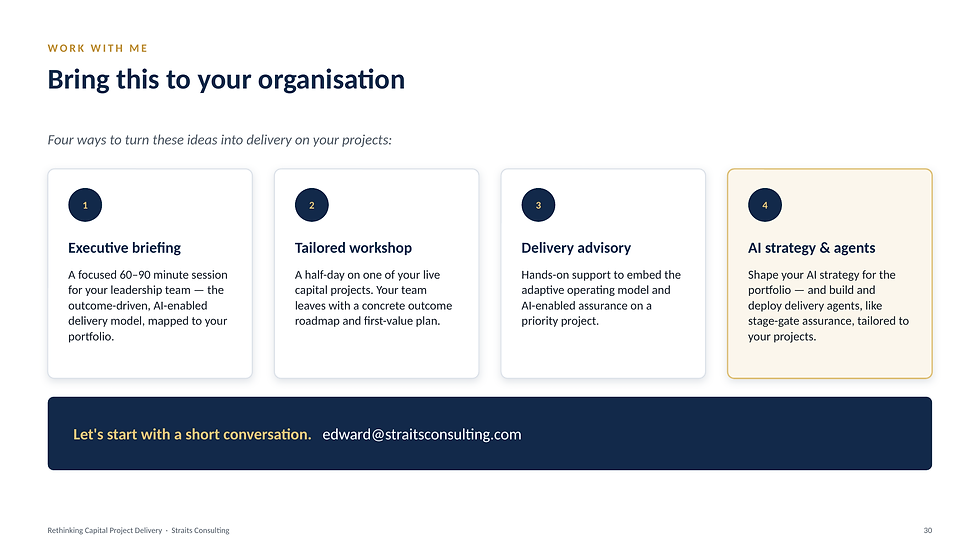
And if you'd like to explore what it looks like on one of your live projects, let's start with a short conversation: edward@straitsconsulting.com
Edward

Comments